It is easy to become overwhelmed when starting to learn to code, but knowing the appropriate beginner-friendly language can make the process much easier. There are languages that are made in such a way that they are easy to read, forgiving to errors, and can expand as you develop. Choosing a language that aligns with your purpose, be it to create websites, apps, or data tools, can keep you motivated and move more quickly. The five beginner-friendly languages listed below are popular, well documented and have giant communities.
1. Python: The Friendly All‑Rounder
Python is among the most popular introductory languages due to its simple and readable syntax and wide applicability. It employs plain English key words and very little punctuation marks, thus a line of code appears more like a sentence than a soup of symbols. Python is employed in web development, data analysis, machine learning, automation, and even beginner games, so it is the language to use when you are not certain what you want to create. It is easy to find help when you get stuck with tons of free tutorials, official documentation and beginner communities. The popularity of Python also translates into employment in most of the technical associated sectors, not only pure software development.
2. JavaScript: The Language of the Web
JavaScript is necessary in case you wish to create interactive websites or web applications. All modern browsers support JavaScript, which allows you to build buttons that act on clicks, forms that validate, and pages that do not need to refresh. Although it is not without its idiosyncrasies, recent tutorials and frameworks such as React make the process easier. Novices usually begin with simple manipulation of the DOM, e.g., changing the text, colors, and visibility of the elements, and then proceed to more advanced tools. It is also possible to learn JavaScript and then do full-stack web development, as it is used on the front end and, with Node.js, the back end of web applications.
3. HTML and CSS: The Building Blocks of Websites
Technically, HTML and CSS are not programming languages such as Python or JavaScript, but they are a must-have tool to any person who intends on developing on the web. HTML determines the layout of a page, including headings, paragraphs, links, images, and forms, and CSS determines the appearance of those elements, including colors, fonts, spacing, and layout. These two are good to learn before you get into the depths of programming, as they will give you an idea of how digital content is structured. Most novices start with HTML and CSS since the feedback is more visual; you can see what each code line will do immediately. As soon as you learn them, it seems like a natural progression to add JavaScript on top.
4. Scratch: A Visual Way to Learn Coding Concepts
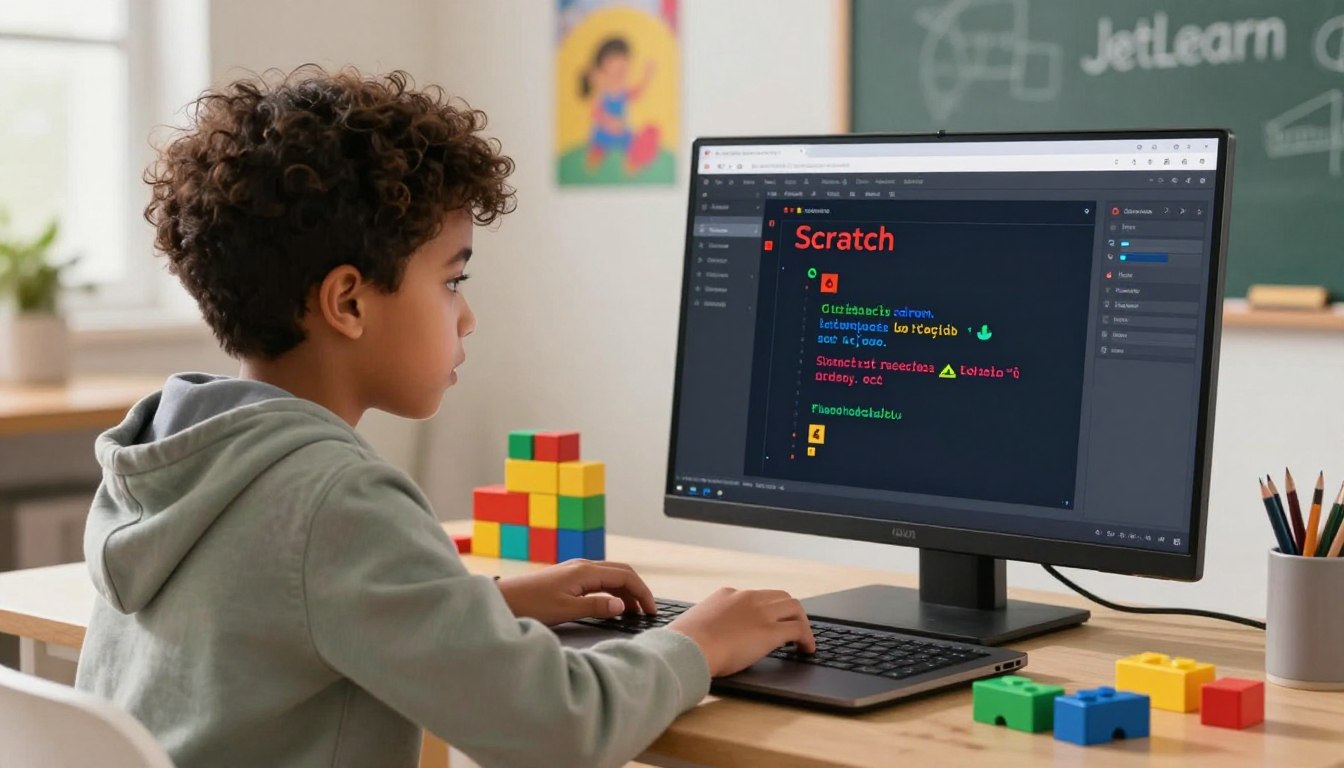
Scratch is a visual programming language that teaches absolute beginners, particularly younger students, or people with no prior experience of logic and structure. You drag and snap together colored blocks that are variables, loops, conditionals and events instead of typing text. This allows you to play around with programming concepts, such as sequences, repetition, and decision-making, without syntax errors to worry about. Scratch is popular in schools and coding camps, but adults may also use it to become familiar with simple logic before graduating to text-based languages. The abstract concepts are concrete and intuitive because of its playful and visual approach.
5. Ruby: Simple and Readable for Beginners
Ruby is a language that is said to be elegant, readable and easy to learn, particularly web development. The syntax is reminiscent of colloquial English and the language is intended to be human-friendly, not necessarily technical. Ruby on Rails is a popular web framework written in the Ruby language that allows novices to develop full-fledged web apps in a short time after mastering the minimum skills. Although Ruby is not as prevalent in large-scale enterprise as Python or JavaScript, it is still a popular language in startups and small companies, and it provides useful ideas on web servers, databases, and user interactions. Ruby is a friendly language to beginners who like clean and simple code.
With either of these beginner-friendly languages, you can gain confidence, learn to solve problems, and open the door to more sophisticated programming, by investing a few weeks in it.